

For a lot of Australians, wisdom teeth only come to mind when a dentist points them out on an X-ray or they start aching during uni exams. They seem late, awkward and often troublesome. So why do we have them at all, and do they still matter?
What exactly are wisdom teeth?
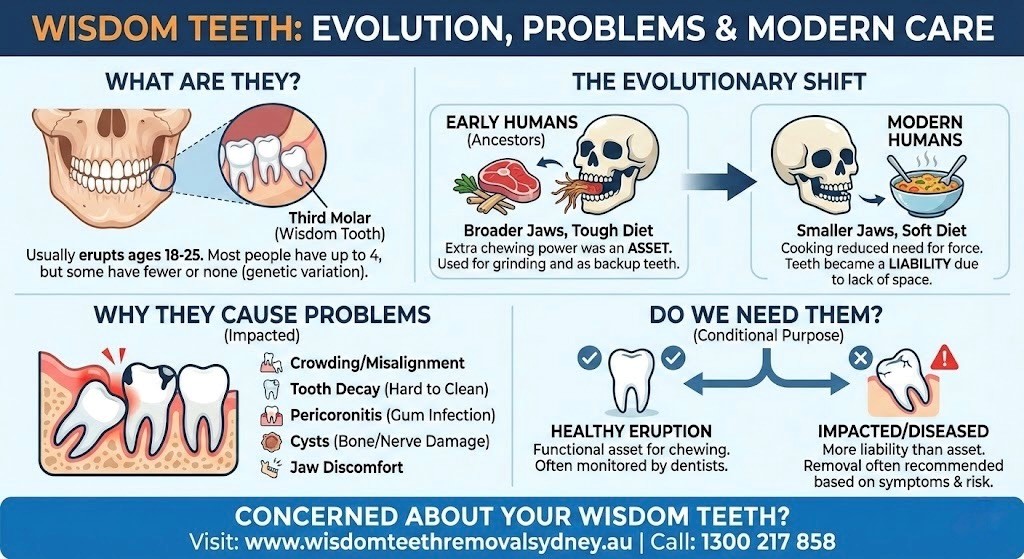
- Wisdom teeth are the third molars at the very back of your mouth.
- Most people develop up to four of them, and they usually erupt between 18 and 25 years of age, although some arrive earlier and some never appear.
- They are part of the normal pattern of adult teeth. The twist is that not everyone develops the same number. Some people have all four, some have one or two, and a noticeable minority have none at all, likely due to genetic variation in tooth development.
- When wisdom teeth erupt fully and line up neatly with the rest of the bite, they can function like any other molar. The problems start when the jaw doesn’t have enough room, so the tooth becomes “impacted” or only partly erupts through the gum.

Understanding the History of Wisdom Teeth
To understand why we even grow these extra molars, it helps to look backwards.
Early humans had broader jaws and ate a much tougher diet: raw meat, fibrous plants and food contaminated with grit and sand. Extra chewing power was an asset. Third molars added grinding surface area, helped manage tooth wear and acted as a backup if earlier molars were lost.
Over thousands of years, our diet changed. Cooking, food processing and utensils meant we did not need the same level of chewing force.
At the same time, evidence suggests our jaws gradually became smaller relative to our teeth, especially with the rise of softer, processed foods.
So wisdom teeth are best seen as an evolutionary leftover: useful for our ancestors, but often poorly matched to modern jaws.
Why wisdom teeth often cause problems
This mismatch explains why so many people have impacted wisdom teeth. When there isn’t enough space, a wisdom tooth can grow at an angle, press on the tooth in front or stay trapped in the bone. Research suggests that globally, around a quarter of adults have at least one impacted third molar, with some populations showing much higher rates.
Impacted or partially erupted wisdom teeth can lead to:
- Crowding and misalignment of nearby teeth
- Tooth decay in the wisdom tooth and sometimes the adjacent molar, which is hard to clean
- Pericoronitis, an infection in the gum flap over a partly erupted tooth
- Cysts around an unerupted tooth, which can damage bone and nerves
- Ongoing jaw discomfort or headaches
These complications are well documented in clinical guidelines and reviews, and they are key reasons dentists recommend removal in many cases.
Do we still need wisdom teeth today?
Functionally, if wisdom teeth erupt straight, fully and remain easy to clean, they can contribute to chewing just like any other molar. In that situation, many dentists prefer to leave them in place and monitor them with regular check-ups and X-rays.
Sydney dentists generally do not support automatic removal of all wisdom teeth. The decision is based on:
- Current symptoms (pain, swelling, infection)
- Evidence of damage to nearby teeth or bone
- Risk of future problems, judged by position and X-rays
- Your age and overall health
Dentists often compare X-rays taken before and after wisdom teeth removal to assess bone healing and to confirm there are no retained fragments.
So, do wisdom teeth have a purpose? Historically, yes. Today, their “purpose” is conditional. If they erupt well, they can still help with chewing. If they are impacted or diseased, they are more liability than asset.
Living with or without your wisdom teeth
If you keep your wisdom teeth, the priority is excellent cleaning.
If removal is recommended, the procedure may be done under local anaesthetic in the chair, or under sedation or general anaesthetic for complex cases.
Good planning for wisdom teeth removal recovery includes arranging a lift home, planning soft foods for a few days and following your dentist’s instructions about pain relief.
Talk to a Dentist in Sydney:
Get your wisdom teeth removed quickly and affordably with Wisdom Teeth Removal Sydney’s experienced team and FREE consultation. Book online today athttps://wisdomteethremovalsydney.au/
FAQs about wisdom teeth
1. Do wisdom teeth have a purpose?
Historically, wisdom teeth provided extra chewing surface to deal with coarse, unprocessed foods and to replace worn or lost molars. In modern diets, their functional value is modest, and their main importance lies in whether they erupt cleanly and stay healthy.
2. What will happen if a wisdom tooth is not removed?
If a wisdom tooth is healthy, fully erupted and easy to clean, it may never need removal. A problematic impacted tooth, left alone, can lead to pain, infection, decay in neighbouring teeth, cyst formation and crowding that may undo orthodontic work.
3. What causes wisdom teeth to develop?
Wisdom teeth develop as part of the standard pattern of adult dentition, influenced by genetics, growth of the jaws and environmental factors such as diet. The teeth themselves form reliably, but jaw size often does not keep pace, which is why impaction is common.
4. At what age do wisdom teeth usually appear?
Most wisdom teeth erupt between the late teens and mid-twenties, often around 18–25 years of age. Some remain unerupted for life, and others emerge earlier or later, which is why regular dental X-rays in adolescence and early adulthood are recommended.
5. How do I know if my wisdom teeth need to be removed?
You can’t reliably judge this at home. Dentists look at symptoms, mouth examination and X-rays to assess position, available space and any damage to nearby structures. They then weigh the risks of surgery against the risks of leaving the tooth in place.