

A sore patch behind your last molar can make anyone suspicious. If you’ve had a third molar removed, the question often lands quickly: can wisdom teeth grow back? In humans, a fully extracted permanent tooth does not regenerate. Adults don’t have a natural “spare set” waiting to replace it, and the tissues that form a tooth in childhood are no longer active in the same way later on.
That said, people aren’t imagining things when they feel something sharp or swollen at the back of the mouth. The science-backed answer is that “regrowth” is usually a lookalike problem, and it’s worth sorting out because the treatment depends on the cause. Wisdom teeth commonly erupt between about 18 and 25, and they don’t always come through cleanly, which adds to the confusion.
Why it looks like wisdom teeth grew back
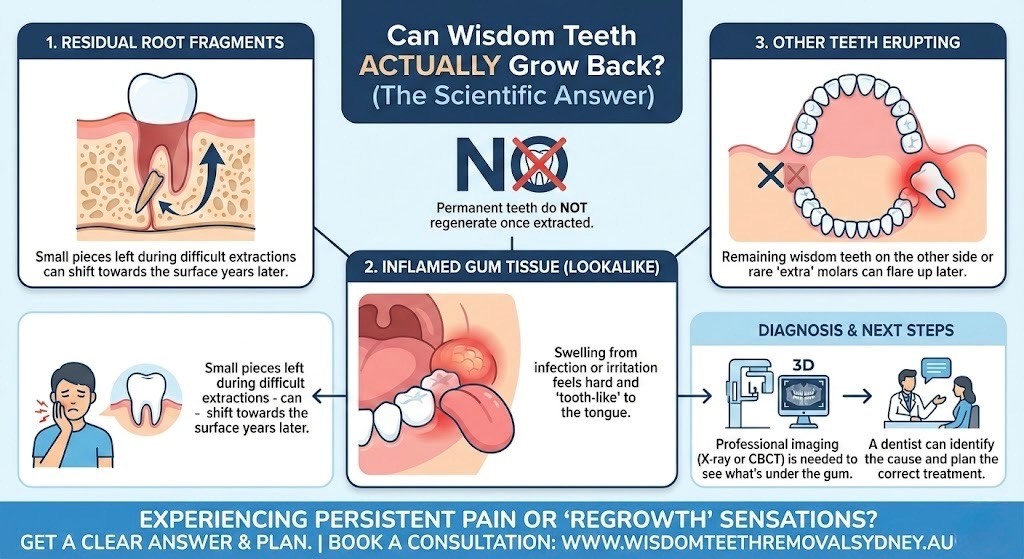
Most “it’s back” stories start with sensation, not sight. The gum behind the second molar can swell after a bout of food trapping, a cold, stress-related clenching, or mild infection. When that tissue is puffy, it can feel like a hard edge. Your tongue then checks the spot constantly, which makes it feel bigger and more definite than it is.
Another common mix-up is timing. Some people had only one or two wisdom teeth removed, not all four. Others never developed all four in the first place. If a remaining tooth on the opposite side flares up later, it’s easy to assume the extracted one has returned. Wisdom teeth can also partially erupt and stay half-covered by gum, which can become irritated and sore.
If pain keeps coming back, a dental examination plus imaging is the sensible next step. You can’t reliably diagnose the back of the jaw by feel alone.
When the “tooth” is really a leftover piece: residual roots after extraction
Extractions are usually straightforward, but anatomy can be awkward. Molars can have curved or fragile roots, and fractures can happen during removal. Sometimes a clinician intentionally leaves a small root tip if the risks of chasing it (particularly near nerves or the sinus) outweigh the benefit. Retained roots are a recognised outcome of extraction, and they can later be seen on radiographs or become symptomatic.
A retained fragment may sit quietly for years. In other cases, changes during healing and bone remodelling can bring a small piece closer to the surface, where it feels like a hard splinter.
People often describe this as a tooth “pushing out”. It’s understandable, but it’s not a new crown growing. A dentist can usually tell the difference quickly with a clinical exam and imaging.
Getting a clear answer in clinic: CBCT scan for wisdom teeth
Most checks begin with a standard dental X-ray. It can show whether a tooth remains, whether an extra molar is present, or whether a fragment sits in the bone. When the situation is complex, three-dimensional imaging may help. CBCT can be used to assess the relationship between lower third molar roots and the inferior alveolar nerve, which matters when planning safe surgery or further treatment.
If you have persistent pain, swelling, discharge, a bad taste, or a recurring gum flap behind the second molar, book a review. Bringing previous radiographs (if you have them) can speed things up, especially when the question is whether something “new” is actually something that was always there.
Book a consultation with Wisdom Teeth Removal Sydney for a clear plan, comfort-focused care, and transparent pricing tailored to your case. Call 1300 217 858 or book an appointment online to visit the clinic.
Also Read: Essential Questions to ask Your Dentist Before Wisdom Teeth Removal

Frequently Asked Questions
1.Can wisdom teeth actually grow back after extraction?
No, not in the sense of the same tooth regenerating. Once a wisdom tooth is completely removed, the body doesn’t recreate a new third molar. When symptoms appear later, dentists usually investigate gum inflammation, decay in the neighbouring molar, a retained root fragment, or an additional tooth that never erupted at the time of surgery. Imaging is the quickest way to confirm what’s happening.
2.Do wisdom teeth grow back years after removal?
Years-later discomfort is more often linked to a different issue: a remaining wisdom tooth on another side, delayed eruption of an unerupted tooth, or irritation around the second molar. Retained fragments can also become noticeable later. If you develop increasing swelling, fever, or difficulty opening your mouth, treat it as urgent and seek care promptly.
3.Why does it feel like my wisdom tooth is growing back?
Because the back of the jaw is a hotspot for swelling and pressure. A gum flap can thicken, food can pack into the area, and sore tissue can feel like a firm lump. Some people also feel sharpness from a small fragment or a bit of healing bone at the extraction site. A dental exam and X-ray can separate irritation from something that needs removal.
4.Can you have more than four wisdom teeth?
Yes. Extra teeth (supernumerary teeth) can occur, including extra molars behind the wisdom teeth. They are uncommon and often impacted. Many are discovered on routine radiographs rather than because they caused symptoms. If an extra molar is poorly positioned or traps food, a clinician may recommend monitoring or removal depending on risk and symptoms.
5.What scan is best to confirm what’s happening (X-ray vs CBCT)?
A standard X-ray is usually enough to check for an unerupted tooth, an extra molar, or retained fragments. CBCT is typically reserved for cases where a three-dimensional view changes management, such as assessing proximity to the inferior alveolar nerve before complex lower wisdom tooth surgery. Your dentist can explain why a scan is recommended and what it will clarify.